INCREASED RANGE

Lucas linear axes (7th axis for robots) increase polyarticulated robots’ range so that they can carry out their activity over long distances.


PRECISE, QUICK AND DYNAMIC

The LUCAS range allows all the polyarticulated robots on the market to move precisely, quickly and dynamically. Several carriages can work on one rail at the same time, whether collaboratively or to improve productivity.


A RANGE OF OPTIONS

The beams may be extended through joining to another beam even after installation. There are various options available: robot chair, coupled carriage, ATEX version…


Characteristics:

Linear axes on pillars increase your polyarticulated robots’ range, so that they can act over long distances.
Precise, quick and dynamic.


Key points:

Thanks to the Lucas configuration tool, it is easy to choose the high axis (on pillars) you require.

We have already tried around one hundred robots to find out if they can be hung upside down (ceiling mounted), at 90 degrees (wall mounted) or the right way up. You will no longer have to read the builders’ technical sheets during your preliminary design to find our whether or not your robot can be suspended.

Lucas axes on pillars also offer a host of options that make them easy to integrate, such as leg offset (see configuration tool), cable carrier position, etc,

Compatible with all industrial robots on the market. See configuration tool


Models from the range:

ALE - High linear axes
ALEP - Protected high linear axes
ALCS - Standard wall mounted linear axes
ALIS - Standard ceiling mounted linear axes

Type
  • Barcode Scanner
  • Feeders
  • Cobot Tracks
  • Cobot- Platforms
  • Actuators
  • Energy chain kit
  • Protective covers
  • Safety and certification

LINEAR AXES ON PILLARS Alternatives

See all 63 Linear Motion Systems
YAMAHA Multi robots
No reviews yet.
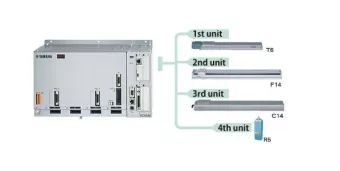
Yamaha's multi-robot operation is an innovative solution that allows for the operation of multiple single-axis robots using a single controller. This operation provides several advantages over operating multiple single-axis controllers. Firstly, the sequence control is simple and easy to manage, as all the robots are controlled by a single controller. This helps reduce the complexity of the control system, making it easier to operate.Secondly, using a multi-axis controller reduces the overall cost of the system upgrade. Instead of replacing all the single-axis controllers, only the multi-axis controller needs to be upgraded, leading to cost savings. Furthermore, the compact design of the multi-axis controller helps save space compared to operating multiple single-axis controllers, which is especially useful in applications where space is limited.Another advantage of multi-axis controllers is that they allow for more sophisticated control. For instance, Yamaha's multi-axis controllers RCX221, RCX320, and RCX340 provide mixed control of the PHASER series and FLIP-X series. This means that users can operate different types of robots with different capabilities and functions, allowing for more advanced and versatile applications.Overall, Yamaha's multi-robot operation is an innovative solution that provides several advantages over operating multiple single-axis controllers. It simplifies sequence control, reduces costs, saves space, and allows for more sophisticated control.
KUKA Robot linear unit KL 4000
No reviews yet.
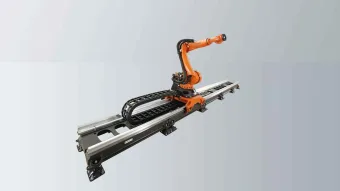
The KL 4000 stands out due to the compact design of the carriage. An optimized motor and gear unit arrangement, the effective travel is increased by 0.4 meters compared to the KL 1500-3. The KL 4000 also enables simple and flexible planning, as the robots of the KR QUANTEC and KR FORTEC series can both be fastened on the same carriage. For even greater flexibility, up to four carriages can be operated on the KL 4000 at the same time.Features: Simple planningThe KL 4000 is equipped with identical mounting bases for KR QUANTEC and KR FORTEC robots. This reduces the number of required anchor points for the mounting base by up to 40 percent compared to the KL 1500. Both robots can be fastened on the same carriage thanks to the identical hole patterns.Optimized installationAn innovative mounting base concept in which the mounting base is fastened by means of a flexible bolt-on system. Installing the KL 4000 does not require welding work. This saves time during installation. Furthermore, the axis can be readjusted at any time.Reduced floor space requirementThe cable carrier is routed internally for a travel of up to 8.4 meters – and can be used for up to two carriages. This reduces the footprint of the linear unit. At the same time, the KL 4000 reaches a length of 31.5 meters with a travel of 30.4 meters – thereby enabling a large workspace.Ease of servicingThe motors and gear units are arranged in such a way that they can be exchanged without having to remove the robot. The same applies to the rollers, which can be exchanged quickly and easily in different positions of the KL 4000. The flexibly adjustable backlash and the optional permanent lubrication unit ensure maximum reliability.