
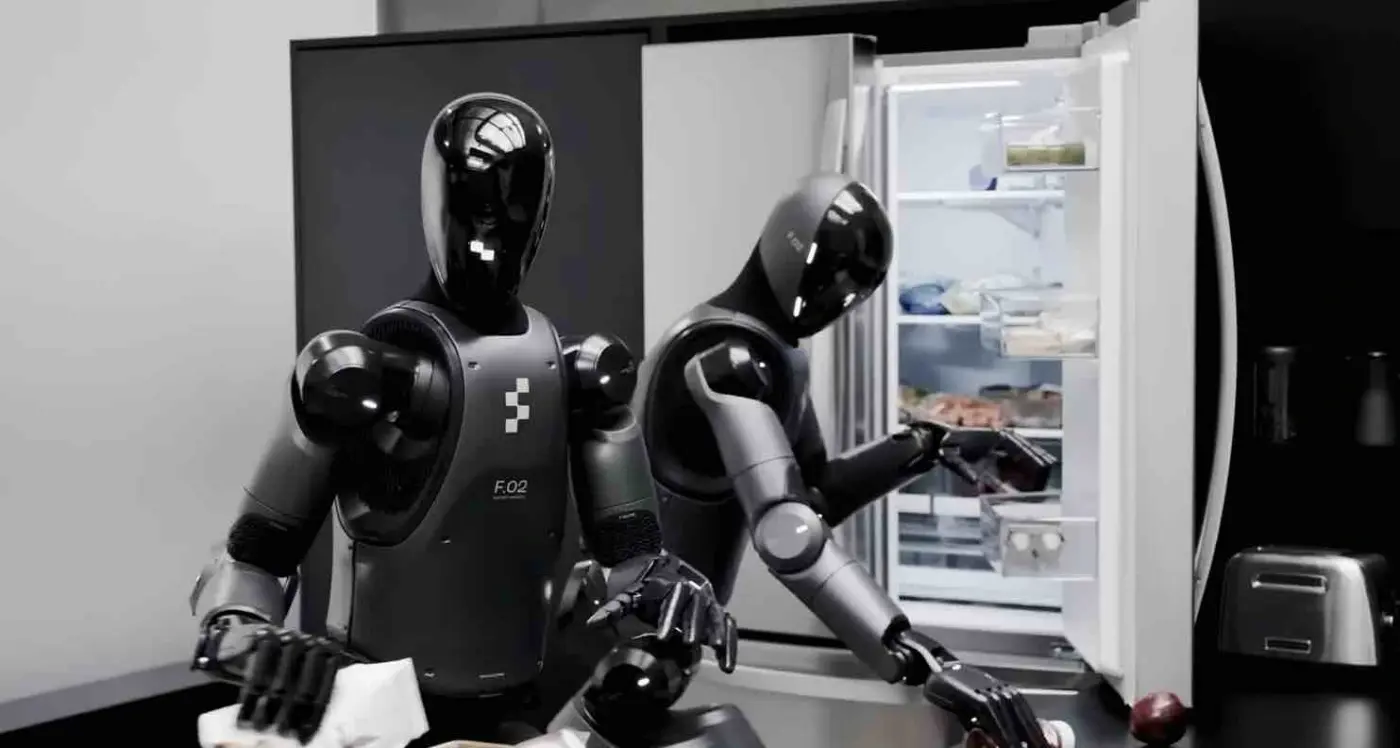
Humanoid robots are robots built to look and move like humans. They usually have two arms, two legs, and a head. The goal is simple: let the robot work in spaces designed for people, using the same tools and workflows you already have. Today, many of these robots are marketed as AI-powered. But when you look closer, most of them do not run a full AI stack. So why is that? In this article, you will learn what an AI stack really means for humanoid robots, and why power limits, safety, data, and control complexity still push engineers toward more traditional solutions.
What an AI Stack Means for Robotics:
An AI stack combines layered technologies that enable a robot to move beyond fixed routines. At the base, it includes sensors that detect the environment. Above that are systems that interpret what those sensors see. Next are decision-making and planning layers that decide what to do. At the top is adaptive control that adjusts actions in real time based on feedback. In robotics this means perception, reasoning, planning, and adaptive control all work together to enable truly intelligent machines. An AI stack turns raw data into decisions that change how the robot behaves in new situations.[1]
Perception and Reasoning:
Perception includes computer vision, depth sensing, and audio processing that help a robot understand its surroundings. For real autonomy these systems must not just sense but reason about what they see. Robots with strong perception can detect obstacles, recognize objects, or interpret human gestures. Decision layers use that information to choose the best action, not just replay a fixed instruction.
Traditional Control Systems:
Most industrial robots use simple control software. They follow precise, predefined motions without interpretation or context. These systems are reliable but lack adaptive autonomy. Contrast that with an AI stack where the robot continually updates its plan based on new data. Perception and reasoning are what separate reactive machines from genuinely intelligent robots.
Current State of Humanoid Robotics:
Humanoid robots are gaining attention in research and demos around the world. You can see them at global competitions like the World Humanoid Robot Games, where more than 500 robots competed from teams in 16 countries. These robots can run, climb, and even box in front of crowds. Yet most of them still need human help for repairs or resets when something goes wrong.
Progress and Limits:
Researchers have made real progress in basic movement, balance, and perception. Modern robots can handle simple grasps and obstacle navigation that would have been impossible a decade ago. However, most prototypes still struggle with real tasks outside controlled environments. They typically operate for only a few hours on a battery charge, far less than an 8 to 12 hour production shift you expect on a factory floor. [2]
AI in Humanoids Today:
Technologies like computer vision and natural language processing do exist in humanoids, and some use vision models or simple language systems. But these capabilities are still limited in scope and often cannot handle complex interactions or unpredictable real‑world settings without human supervision or precise conditions.
Robots With Limited or Partial AI Stacks:
Most humanoid robots that you see today use some level of artificial intelligence, but it is often focused on interaction rather than full autonomy. These robots illustrate what AI can do in limited scopes and where current technology still falls short for real industrial or general‑purpose use.
Sophia:
Sophia is one of the most famous humanoid robots. She can mimic facial expressions and hold simple conversations using preprogrammed and machine‑assisted speech patterns. However, her responses are largely scripted and tied to predefined topics or interaction patterns rather than deep autonomous reasoning in real environments. She is built more for social engagement and research into human‑robot interaction than autonomous task execution on a work floor.
This video shows Sophia, one of the most recognised social humanoid robots exhibiting facial expressions and conversation in public settings. It helps illustrate interaction-focused AI rather than full autonomy.
Nadine and Similar Social Robots:
Social humanoids like Nadine focus on human interaction rather than industrial performance. The robot can recognise people it has met before and recall stored information about them. It also uses speech recognition and gestures to maintain natural conversation flow. These features make it effective for reception areas, education, or public engagement. However, this type of AI is built for controlled social scenarios and demonstrations. It is not designed to handle complex tasks such as assembly, inspection, or material handling on a production line.
Research Platforms:
Research platforms such as iCub are widely used for experimentation in perception and cognition. These robots help engineers and scientists test new algorithms in controlled settings, but they are not ready for robust deployment in everyday industrial operations. Studies show that many such robots only achieve partial autonomy and still require significant human supervision.
Humanoids With AI Stacks:
In the broader humanoid landscape a few robots go beyond traditional control and embed stronger AI capabilities. These are not perfect autonomous machines yet but they illustrate where the technology is heading. This section shows real examples that use AI for perception, reasoning, and adaptive behaviour in ways that most robots do not.
Tesla Optimus:
Tesla’s Optimus is designed with an integrated AI stack for real‑world tasks. According to the official Tesla AI page, the robot’s software aims to combine perception, motion planning, and interaction in unstructured environments. The company is hiring engineers in deep learning, planning and control to build these layers into Optimus. This approach pushes the robot past scripted motions toward adaptive autonomy.
This official Tesla video shows the Optimus humanoid walking and performing tasks. It helps illustrate where AI integration is advancing beyond scripted interaction.
Figure 03:
Figure AI’s Figure 03 uses a proprietary Helix AI system designed to interpret sensor data and support reasoning for tasks at home or work. The robot features an advanced sensory suite engineered for vision‑language‑action integration, which helps it perceive its surroundings and make task decisions.
This video showcases Figure 03, an example of a humanoid with a stronger AI stack for perception and reasoning, useful as a contrast to limited autonomy robots.
1X NEO:
The 1X NEO humanoid is built with AI layers that enhance perception and navigation. It uses visual input and built-in connectivity to update behaviour based on new information, and the company plans to extend autonomous learning with world models that let the robot learn directly from its own footage.
Social Interaction Robots:
Robots like Ameca demonstrate AI in human interaction through voice recognition and computer vision. While not general‑purpose task robots, they show how AI can be layered for perception and dialogue before being expanded into broader autonomy.
These examples are steps toward full AI stacks but still require more development before achieving the kind of autonomy you might expect in complex industrial environments.
Engineering and AI Challenges That Limit Full AI Stacks:
Building full AI stacks for humanoid robots is not just a software problem. You need solutions for hard engineering issues that affect reliability, safety, and performance. These challenges explain why most humanoids use traditional control systems rather than end‑to‑end AI stacks.
1. Physical Complexity and Control:
Humanoid robots must balance, move, and coordinate many joints to perform tasks. This is difficult even with fixed routines. Most production robots rely on classical motion control systems that you can predict and tune precisely. According to research, real‑time control and stability remain top challenges for dynamic locomotion and manipulation.
2. Data Scarcity:
AI models need large datasets to learn. Language models train on trillions of words. In contrast there is far less motion and interaction data for humanoid robots. Simulations help but they cannot fully mimic real physics and contact forces, which remain a major gap in training autonomous behaviours.
3. Compute and Power Constraints:
AI stacks require heavy processing and high energy use. Humanoid robots run on batteries with limited power. This makes it hard to run advanced perception and planning in real time without overheating or draining power quickly.
4. Safety and Reliability:
Industrial automation demands predictable performance. Autonomous AI that changes behaviour based on context can produce unexpected actions. Engineers prefer systems with clear limits and fail‑safe modes. This prioritizes reliability over adaptive autonomy in most current humanoids.
Emerging Trends: Towards Full AI Stacks
The robotics industry is beginning to build systems that edge closer to full AI stacks. One key trend is the use of world models and foundation models that help robots understand and predict physical environments. These models aim to integrate perception, reasoning, and planning into a unified framework, which is a step toward autonomy rather than fixed routines. Researchers have developed open world models that forecast future observations and help robots anticipate outcomes based on actions. This research suggests a path for embodied AI that goes beyond traditional control.
Foundation Models in Robotics:
Foundation models are powerful AI systems trained on large datasets and used across multiple tasks, including vision and language. In robotics, they show potential to improve perception, decision‑making, and control by transferring learned knowledge into autonomous behaviour. However, the field still faces challenges with data scarcity, safety guarantees, and real‑time execution.[3]
Progress But Limited Adoption:
Industry momentum is visible, and national initiatives aim to support full‑stack humanoid ecosystems. Yet production‑ready AI stacks remain rare outside of research prototypes and experimental platforms. Progressing from laboratory models to reliable, industrial‑grade AI stacks continues to require breakthroughs in hardware, data, and safety. [4]
Conclusion:
Most humanoid robots today do not have full AI stacks. The reasons are practical and engineering‑based. Balancing and coordinating multiple joints is complex. Data for training autonomous behaviours is limited compared to what large AI models use. Processing power and battery life constrain what can run on a mobile robot. Safety and reliability requirements make unpredictable AI behaviour risky in real environments. For now, engineers rely on a mix of traditional control systems and selective AI modules for perception or simple decision‑making. This approach is the practical reality. Over time, as hardware, data, and algorithms improve, humanoid robots will become smarter and more capable.
References:
- IBM. AI stack in robotics. Retrieved on 6 January 2026, from https://www.ibm.com/think/topics/ai-stack?
- McKinsey & Company. Humanoid robots crossing the chasm from concept to commercial reality. Retrieved on 6 January 2026, from https://www.mckinsey.com/industries/industrials/our-insights/humanoid-robots-crossing-the-chasm-from-concept-to-commercial-reality?
- IBM. Foundation models. Retrieved on 6 January 2026, from https://www.ibm.com/think/topics/foundation-models?
- McKinsey & Company (Germany). Humanoid robots crossing the chasm from concept to commercial reality. Retrieved on 6 January 2026, from https://www.mckinsey.de/industries/industrials/our-insights/humanoid-robots-crossing-the-chasm-from-concept-to-commercial-reality?
End-of-arm tooling transforms generic robots into specialized tools
by Jeremy Cook, contributor to GlobalSpec Industrial robot arms – whether six-axis, SCARA, delta or [...]

5 Cybersecurity Threats in Automated Systems
Cybersecurity challenges continue to be a problem in the industrial automation field. In 2025, 50% [...]
Aug
Robot Operating System 2026: 5 Tips for Buyers
For more than ten years, the Robot Operating System (ROS) has served as the backbone [...]
Aug
Digital Twins in Robotics: 5 Things to Know
Robot digital twins are transforming the way robots are built, programmed, and maintained, and they [...]
Jun

Top 6 CNC Machine Trade Shows 2026
We’re halfway through 2026, and the most important CNC machine trade shows are still ahead. [...]
Jun
What is Time Sensitive Networking?
In modern manufacturing, robots, sensors, and motion control devices must be in total harmony with [...]
1 Comments
May