
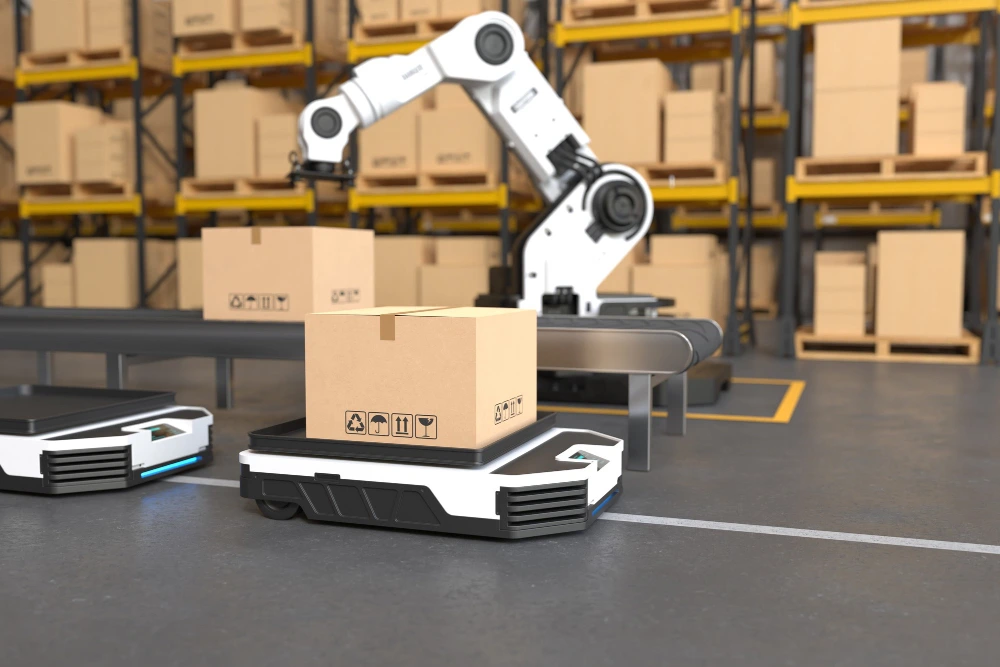
Every minute a mobile robot spends off the floor is a minute of lost productivity. As AMRs and AGVs become the backbone of modern industrial operations, navigating warehouse floors, transporting components across factory lines, and fulfilling orders around the clock, the question of how they stay powered has never been more consequential. At the heart of this lies a fundamental choice: swappable batteries or fast charging. Each approach carries its own operational logic, infrastructure demands, and cost implications, and this article breaks down both strategies to help you determine which best fits your fleet, and your facility.
Why Lithium-Ion Dominates
Before choosing a charging strategy, it helps to understand what is doing the actual work. Lithium-ion batteries, including LiFePO4 and NMC variants, now hold over 85% of the robot battery market.[1] Compared to legacy lead-acid systems, they offer faster charging, higher energy density, and significantly lower maintenance overhead. The cycle life averaging around 3,500 cycles across AMR and AGV deployments.[2] Not all lithium-ion chemistries are equal, however. LiFePO4 (LFP) is the preferred choice for 24/7 industrial AMRs due to its intrinsic safety in environments with high-value equipment or flammable materials.[3] NMC offers higher energy density for robots where size and weight are more constrained. Solid-state and graphene-enhanced batteries are emerging as the next frontier for mobile robot power systems.
Swappable Batteries
A swappable battery system is exactly what it sounds like: a human operator or automated mechanism physically removes a depleted battery pack and replaces it with a pre-charged one. In optimised setups, this process takes as little as 84 seconds, making it the fastest way to return a robot to operation. Swappable batteries also support partial top-up strategies, keeping AGVs operational by topping up batteries instead of waiting for a full charge.[4] The infrastructure requirement, however, is not trivial. Multiple charged packs per robot must be on hand at all times, charging bays must be provisioned for spare packs, and every robot added to the fleet demands a proportional increase in battery inventory.
Manual swapping requires trained staff, while automated swapping requires robotic handling equipment, each carrying its own cost and complexity. Battery swapping is best suited to environments where human support is always present and downtime must be near-zero,[5] particularly shift-based operations with natural handover windows. The core limitations are standardisation and scale: battery packs are rarely interchangeable across robot models or brands, and as fleets grow, inventory costs grow with them linearly, making this approach harder to justify at larger scales without careful long-term planning.
Fast Charging
Where swappable batteries rely on human or mechanical intervention, fast charging puts the robot in control. The robot autonomously navigates to a charging dock and connects, either through a physical electrode contact or via inductive wireless transfer, with no human involvement required. A key concept here is opportunity charging: rather than waiting for a full depletion cycle, robots top up during natural workflow pauses such as loading, unloading, or waiting for a mission. Lithium-ion batteries can charge in under two hours, with advanced multi-voltage systems achieving as little as 45 minutes, enabling true opportunity charging during short operational breaks.[3] The productivity case is clear: charging inefficiencies currently consume 20 to 30% of total robot operational time across industries of all sizes,[6] and shortening that window directly translates to throughput gains.
Infrastructure investment is real, though: standard AMR charging points range from USD 10,000 to USD 50,000, with advanced options costing more.[7] Autonomous docking is the preferred approach when fleet size exceeds 50 robots or when operating 24/7 in unpredictable environments.[5] The key limitation to manage is battery health: without proper thermal management, fast charging can accelerate battery degradation through heat and chemical stress,[7] making a robust Battery Management System (BMS) not optional, but essential.
Fast Charging: Centralised vs Decentralised Charging
Whichever charging method a facility adopts, where the charging happens matters just as much as how. Centralised charging consolidates all docks or swap bays into a single dedicated zone, which simplifies management and works well in compact facilities with shorter robot travel distances. Decentralised charging distributes power points across the factory floor, reducing the time robots spend travelling to and from a charger, a meaningful advantage in large-scale facilities where that travel time accumulates into measurable productivity loss across a full shift.
In either setup, a BMS becomes essential, coordinating charging schedules, monitoring cell health, and preventing simultaneous demand spikes that could strain the facility’s power grid. The layout decision is not merely logistical; it directly affects fleet efficiency, infrastructure cost, and how gracefully the system scales as the operation grows.
Industry Scenarios: Matching the Method to the Environment
| Environment | Recommended Approach | Rationale |
| 24/7 large-scale logistics warehouse (50+ robots) | Autonomous docking / fast charge | Continuous operation; no fixed shift windows |
| Manufacturing plant (2–3 shifts, human operators present) | Swappable batteries | Near-zero downtime; shift changeover = natural swap window |
| Medical/healthcare facility | Swappable or scheduled fast charge | Not always around the clock; safety critical; sterile environment constraints |
| E-commerce fulfilment (peak seasons) | Hybrid model | Docking as default; swappable as emergency backup during peak |
| SME or smaller operation | Fast charge / opportunity charging | Lower infrastructure investment; simpler to manage |
The Hybrid Approach
Hybrid models are worth considering, relying on autonomous docking for regular operations while keeping swappable packs available for emergencies.[5] This approach gives operations the efficiency benefits of autonomous charging during normal hours, with the speed of a manual swap when peak demand or unexpected failures make waiting impractical. Some facilities are taking this further, exploring energy-sharing between AMRs, where operational robots transfer charge to depleted units, improving fleet performance in industrial and medical environments.[7] The most resilient fleets are not those that chose perfectly between two options, but those that planned for the moments when their primary method falls short.
Conclusion
There is no universal answer to the swappable versus fast-charging debate, and any vendor claiming otherwise is selling infrastructure, not strategy. The right approach depends on fleet size, shift structure, facility layout, budget, and how the operation is expected to grow. What is clear is that the stakes are rising, and more operations will face this decision in the years ahead. As battery chemistries improve and charging speeds increase, the gap between both methods will narrow, but the decision framework will remain the same. Know your operation, model your total cost of ownership, and choose the strategy that keeps your robots on the floor, not waiting for power.
References:
- Large Power. (2025, November 28). Future trends in robotics batteries: Higher capacity, faster charging, and smarter management. Retrieved on 10 April 2026, from https://www.large-battery.com/blog/future-trends-robotics-batteries-higher-capacity-faster-charging/
- RELiON Battery. (n.d.). How lithium batteries improve AGVs and AMRs. Retrieved on 10 April 2026, from https://www.relionbattery.com/blog/how-lithium-batteries-improve-agvs-and-amrs
- ZAPI Group. (n.d.). Enhancing autonomous mobile robot performance with lithium-ion battery technology. Retrieved on 10 April 2026, from https://www.zapigroup.com/en/blog/enhancing-autonomous-mobile-robot-performance-with-lithium-ion-battery-technology
- Large Power. (n.d.). AGV & AMR battery systems: Modular and quick-swap advantages. Retrieved on 10 April 2026, from https://www.large-battery.com/blog/agv-amr-battery-systems-modular-quick-swap-advantages/
- Phihong. (n.d.). Swappable battery vs autonomous docking: What leading OEMs are choosing for next-gen mobile robots. Retrieved on 10 April 2026, from https://www.phihong.com/swappable-battery-vs-autonomous-docking-what-leading-oems-are-choosing-for-next-gen-mobile-robots/
- Nyobolt. (n.d.). How ultra-fast charge batteries enable continuous fleet operation. Retrieved on 10 April 2026, from https://nyobolt.com/resources/blog/how-ultra-fast-charge-batteries-enable-continuous-fleet-operation/
- Large Power. (n.d.). Fast-charging swappable batteries for autonomous mobile robots (AMRs). Retrieved on 10 April 2026, from https://www.large-battery.com/blog/fast-charging-swappable-batteries-autonomous-mobile-robots-amrs/
End-of-arm tooling transforms generic robots into specialized tools
by Jeremy Cook, contributor to GlobalSpec Industrial robot arms – whether six-axis, SCARA, delta or [...]

5 Cybersecurity Threats in Automated Systems
Cybersecurity challenges continue to be a problem in the industrial automation field. In 2025, 50% [...]
Aug
Robot Operating System 2026: 5 Tips for Buyers
For more than ten years, the Robot Operating System (ROS) has served as the backbone [...]
Aug
Digital Twins in Robotics: 5 Things to Know
Robot digital twins are transforming the way robots are built, programmed, and maintained, and they [...]
Jun

Top 6 CNC Machine Trade Shows 2026
We’re halfway through 2026, and the most important CNC machine trade shows are still ahead. [...]
Jun
What is Time Sensitive Networking?
In modern manufacturing, robots, sensors, and motion control devices must be in total harmony with [...]
1 Comments
May