
NACHI NH5 Alternatives & Competitors
Ranked Nr. 145 of 408 Industrial (Articulated) Robots
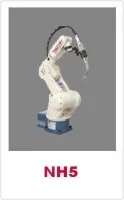
Top 10 NH5 Alternatives
- FANUC ARC Mate 120iD
- YASKAWA SP80
- KAWASAKI BX100L
- NACHI NV6
- NACHI NV6L
- FANUC ARC Mate 50iD/7L
- KAWASAKI RA005L
- KAWASAKI RA010L
- FANUC ARC Mate 120iD/35
- KAWASAKI ZX130L
- KAWASAKI ZX200S

FANUC ARC Mate 120iD
Payload 25kg | Reach 1831mm
YASKAWA SP80
Payload 80kg | Reach 2236mmThe Yaskawa MOTOMAN SP80 is a compact spot welding and handling robot known for its efficiency and versatility. With an 80 kg payload capacity, including the C-adapter, and a 2236 mm working range, it is well-suited for high-density robot lines in car body construction and the economical welding of small subassemblies. Its compact design allows for space-saving installations on various positioners, making it ideal for environments where space is at a premium.
Powered by the advanced MOTOMAN YRC1000 controller, the SP80 features the latest Yaskawa Sigma-7 servo drive technology. This technology provides high dynamics and energy efficiency, contributing to exceptional cycle times and overall operational efficiency. The robot's six-axis configuration and repeatability of 0.03 mm ensure precise and reliable performance, essential for high-quality welding and handling tasks.
The SP80's design emphasizes flexibility with multiple mounting options, including ceiling, wall, and floor configurations. This flexibility, combined with its high-speed capabilities—up to 350 °/s on the T axis—makes it a robust solution for various industrial applications, particularly in automotive manufacturing where precise and efficient spot welding is crucial.

KAWASAKI BX100L
Payload 100kg | Reach 2597mmThe KAWASAKI BX100L is a robust industrial robot designed for high-speed spot welding applications. With a payload capacity of 100 kg and a maximum reach of 2597 mm, it falls under the category of large robots capable of handling significant loads. One of its standout features is its hollow wrist, which houses cables and hoses, thereby reducing wear and tear and improving the robot's longevity. This design makes it particularly suited for managing small to medium-sized weld guns efficiently.
In terms of capabilities, the BX100L excels in spot welding, but it is also versatile enough to be used in assembly and material handling applications. Its precision and speed make it a valuable asset in production lines where efficiency and accuracy are paramount. The BX100L can easily replace older, less efficient robots, offering an upgrade in performance and reliability.
Applications for the KAWASAKI BX100L include car body assembly and auto body spot welding, as demonstrated in industry events like iREX2015. Its ability to integrate seamlessly into existing production setups, combined with its optimized performance for spot welding tasks, makes it a preferred choice in automotive manufacturing and other industries requiring precise, high-speed welding solutions.

NACHI NV6
Payload 6kg | Reach 1402mm
NACHI NV6L
Payload 6kg | Reach 2006mm
FANUC ARC Mate 50iD/7L
Payload 7kg | Reach 911mmThe FANUC ARC Mate 50iD/7L is a versatile arc welding robot designed for high-precision tasks in demanding environments. It features a payload capacity of 7 kg and a reach of 911 mm, which allows it to handle a variety of welding applications with precision. Its six-axis design provides flexibility and maneuverability, making it suitable for complex welding paths and operations.
This model stands out with its slim and lightweight arm construction, which enhances speed and accessibility to parts and tooling. The robot’s improved reach and stroke optimization enable it to maximize its work envelope, making it effective in tight spaces. Additionally, the ARC Mate 50iD/7L includes a flip-over capability, allowing it to operate efficiently in varied orientations and further extend its operational range.
For maintenance, the robot can be equipped with an optional torch maintenance station that automates the cleaning and dressing of welding torches. This feature helps maintain consistent welding quality and reduces downtime, contributing to overall operational efficiency.

KAWASAKI RA005L
Payload 5kg | Reach 903mm
KAWASAKI RA010L
Payload 10kg | Reach 1925mm
FANUC ARC Mate 120iD/35
Payload 35kg | Reach 1831mm
