
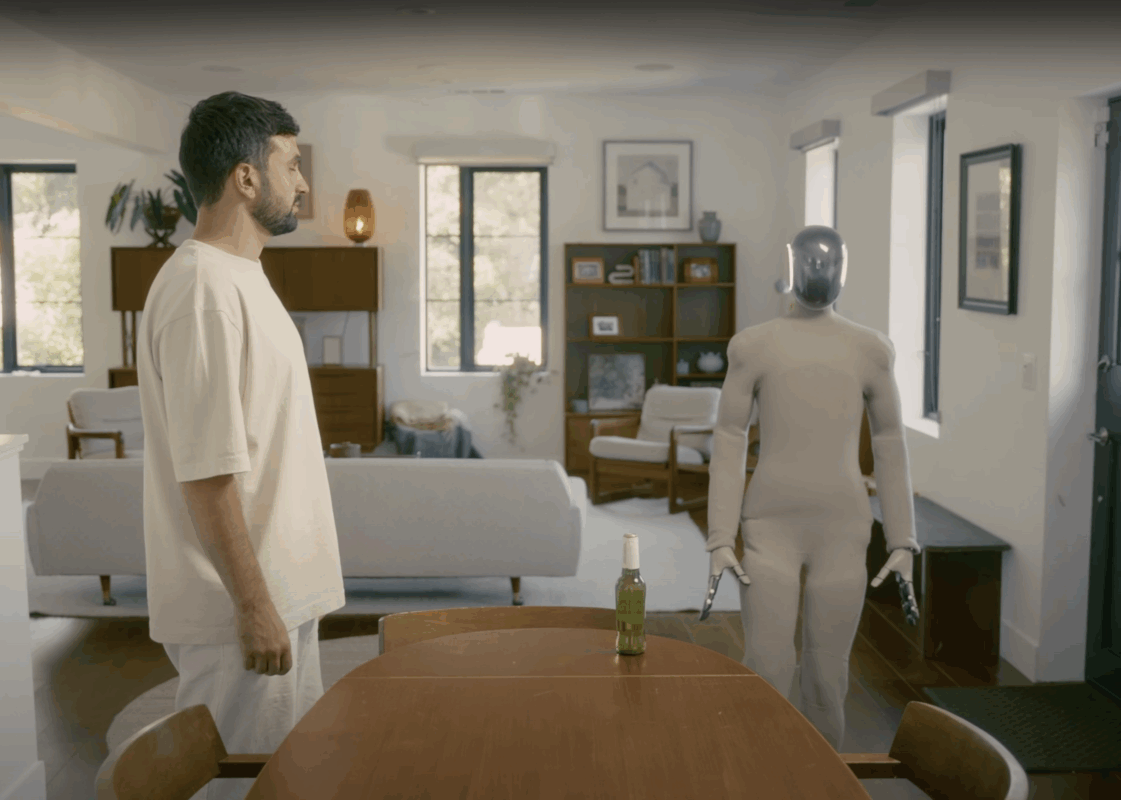
Norwegian robotics startup 1X Technologies has announced a major advancement in humanoid robotics with the debut of Redwood, a proprietary AI model designed to power its NEO humanoid robot. Built to operate in domestic environments, Redwood aims to enable NEO to perform a wide array of household tasks autonomously. The announcement places 1X among the leading players in a competitive global humanoid robotics market, with significant developments also emerging from Figure AI, Tesla, and Unitree Robotics.
Overview On Redwood AI:
Integrated Full-Body Control:
The Redwood AI system marks a departure from traditional robotics architecture by merging locomotion and manipulation. Rather than treating movement and object handling as separate processes, Redwood enables coordinated whole-body control. This allows the NEO robot to perform complex tasks that involve actions like leaning, bracing, and shifting posture for better stability and precision.
Onboard Processing for Efficiency:
Redwood runs entirely on NEO’s onboard embedded GPU, emphasizing compute efficiency. By eliminating the need for constant cloud connectivity, the system enhances reliability and privacy, which are key factors for household use.
Multisensory Data Fusion:
The model combines input from vision, touch, and proprioception to inform its actions. This multisensory approach helps NEO interpret its surroundings more effectively, allowing it to adapt to new objects and environments.
Voice Control via Off-Board Model:
While most of Redwood’s operations are handled locally, spoken commands are still processed through an off-board language model. This setup enables real-time understanding of user intent during conversations and bridges the gap between autonomous behavior and interactive control.
This video showcases 1X’s NEO Gamma humanoid robot using Redwood AI to autonomously navigate a home and perform tasks like object retrieval and interaction.
Trained on Real-World Data:
Learning from Demonstrations:
Redwood was trained on data collected from real-world sessions using 1X’s earlier EVE and current NEO robots. These sessions included human teleoperation and naturally occurring household activities, enabling the AI to learn through direct interaction with its environment.
Advanced Manipulation Capabilities:
The training allows Redwood to perform mobile bi-manual manipulation, recognize objects in cluttered spaces, and choose the appropriate hand dynamically based on the task. These skills help the robot operate more effectively in complex and unstructured settings.
Adaptability and Continuous Learning:
Redwood supports retry strategies when initial attempts fail and continues to refine its behavior over time. Through repeated observation and practice, the system improves its task performance and adaptability.
Purpose-Built for Humanoids:
According to Eric Jang, 1X’s VP of AI, Redwood is among the first end-to-end mobile manipulation systems specifically designed for bipedal humanoid robots operating in household environments.
Household Use Cases and Capabilities:
Domestic Task Proficiency:
1X’s humanoid robot, NEO, is built to perform a wide range of household chores, including:
-
Doing laundry
-
Vacuuming
-
Watering plants
-
Making coffee
-
Tidying up and folding clothes
-
Carrying objects up to 44 pounds
-
Receiving groceries and opening doors
Powered by Adaptive Learning:
These capabilities are driven by Redwood’s learning engine, which uses reinforcement learning from human demonstrations to improve task execution over time.
Designed for Home Safety:
NEO features soft-knit exteriors and compliant actuation, allowing it to interact safely and gently within domestic environments.
Safety and Hybrid Oversight:
Autonomous Operation with Human Backup:
NEO functions autonomously but includes a teleoperation fallback system. Human operators can remotely intervene when the robot encounters unfamiliar or potentially unsafe situations. This hybrid approach supports both AI learning and user safety.
Controlled In-Home Trials
1X has initiated limited in-home trials of the NEO Gamma variant. These early deployments are currently taking place with company employees, aiming to collect user feedback and real-world data to further refine the system.
Competitive Landscape:
Figure AI:
Silicon Valley-based Figure AI is advancing its Helix AI system, recently showcasing real-time adaptive behavior in logistics environments. The company has partnerships with BMW and a logistics firm, with household trials expected to begin in late 2025.
Tesla:
Tesla continues to develop its Optimus robot, which is trained to learn tasks from Internet videos. Despite a recent leadership change following the resignation of robotics head Milan Kovac, the company aims to produce 5,000 units in 2025.
Unitree Robotics:
Chinese firm Unitree Robotics is preparing for a public listing after restructuring as a joint stock company. Its humanoid robots, including the Unitree H1, have received national media coverage and are undergoing expanded commercial trials.
Market Differentiation:
Home-First Design Focus:
1X distinguishes itself by prioritizing household integration over industrial use. Unlike many competitors that deploy robots in factories or logistics centers, 1X’s NEO is designed specifically for domestic settings. Key features include a compact frame, soft materials, and versatile control systems suited for home environments.
Long-Term Vision:
CEO Bernt Børnich outlined a gradual approach to autonomy, highlighting the company’s goal of deploying robots that learn and adapt in the home. Over time, these systems are expected to become increasingly autonomous through continual real-world interaction.
Scaling Plans:
Production Targets:
1X plans to begin large-scale manufacturing of its humanoid robots in 2026, targeting 100,000 units per year. The company’s long-term goal is to eventually scale production into the millions. These projections depend on overcoming technical, financial, and regulatory hurdles.
Development Status:
Redwood-powered NEO robots remain in development, with ongoing software updates and expanded field testing expected to improve performance. Pricing and broader consumer availability have not yet been announced.
Broader Implications:
The rollout of Redwood AI reflects growing confidence in the potential of humanoid robotics. With improved AI models and expanding real-world data, these systems are progressing toward practical and reliable use in home environments.
Remaining Challenges:
Technical and Social Barriers:
Despite progress, experts highlight ongoing challenges, including safety, technical limitations, and regulatory uncertainty. Broader issues like public trust, liability, and ethical concerns also play a critical role in shaping adoption.
Keys to Successful Integration:
Widespread adoption will depend not only on technological readiness but also on affordability, user experience, and a reliable support infrastructure that builds long-term confidence in the technology.
What’s Next?
1X Technologies’ launch of Redwood AI marks a notable step toward general-purpose humanoid robots for home use. NEO’s ability to adapt and operate autonomously in domestic settings reflects steady progress in the field. As Redwood matures alongside competitors like Tesla, Figure AI, and Unitree, the industry faces key challenges in scaling production, ensuring safety, and meeting regulatory standards. The long-term impact of these systems will depend on real-world performance, user trust, and affordability. Whether humanoid robots become common household tools or remain specialized technologies will hinge on how effectively companies refine and deploy their solutions in the years ahead.