
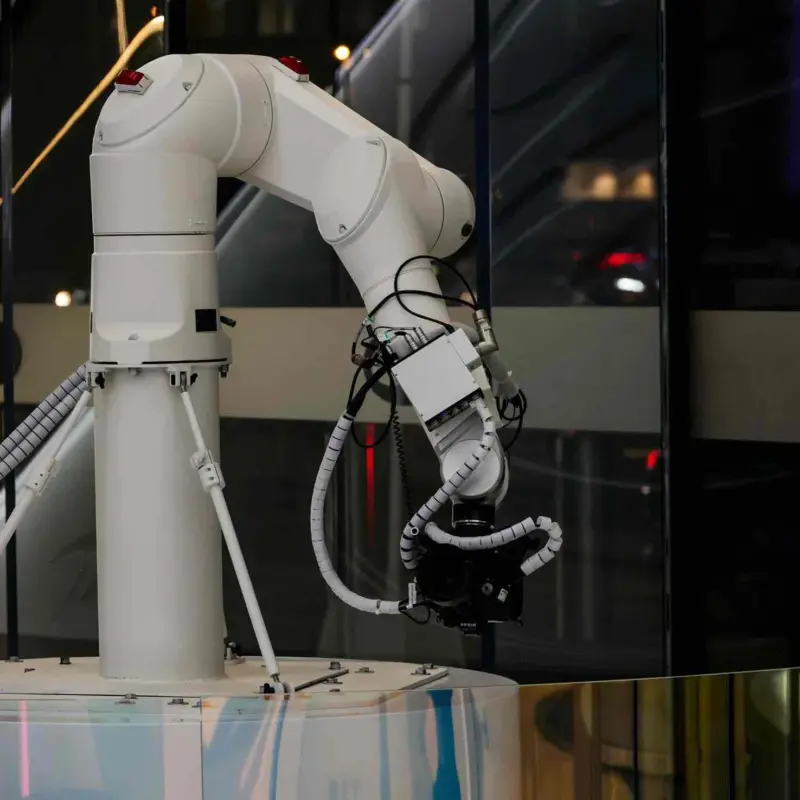
Collaborative robots, or cobots, operate in shared human workspaces. This capability requires robust safety mechanisms. One of the most critical is force limiting. Unlike traditional industrial robots, cobots do not rely on physical barriers. Instead, they control the magnitude of force during contact. Engineers refer to this approach as Power and Force Limiting (PFL). It ensures that any collision remains within safe biomechanical thresholds. The robot continuously monitors motion, torque, and external interaction forces. If limits are exceeded, it reacts instantly. This approach enables direct human-robot interaction while maintaining compliance with international safety standards and preserving operational efficiency in dynamic environments.
What is Force Limiting?
Force limiting, formally called Power and Force Limiting (PFL), is a core safety mechanism in collaborative robotics. It ensures a robot’s applied force remains below injury thresholds during contact. Cobots equipped with PFL can operate directly alongside humans without protective barriers. In practice, force limiting works by continuously monitoring joint torque, external forces, and motion patterns. When a human comes into contact, the system detects deviations from expected motion. If the force approaches predefined limits, the robot responds instantly by stopping or reducing its output.
PFL considers both transient collisions, brief impacts, and quasi-static interactions, such as sustained pressure. It balances protection and productivity, allowing cobots to perform complex tasks while minimizing risk.
The Role of Safety Standards
Force limiting is governed by international safety standards such as ISO 10218 and ISO/TS 15066. These standards set clear rules for collaborative robot design, risk assessment, and operation to protect people in shared workspaces. ISO/TS 15066 provides biomechanical limits based on pain onset data collected from about 100 human subjects, establishing maximum force and pressure levels for 29 body areas under contact conditions.[1]
The specification also defines acceptable contact types, transient impacts and sustained pressures, and outlines how robots must react when limits are reached. Adhering to these standards ensures safe human‑robot interaction while maintaining productivity in industrial settings.
How Force Limiting Works
Force limiting relies on mechanical design, embedded sensing, and real-time control. Cobots use low-mass links, rounded geometries, and compliant joints to reduce impact energy. Lower mass directly reduces kinetic energy during collisions, improving safety margins. Integrated torque and force sensors continuously measure joint loads and external interaction forces. These sensors detect contact within milliseconds and feed data into the control system.
Control algorithms compare expected motion with actual motion. Any deviation signals a potential collision. The system then limits speed, acceleration, and torque output in real time. Studies show that reducing robot speed by 50% can lower impact force by more than 50%, due to the quadratic relationship between velocity and kinetic energy.[2] When thresholds are reached, the robot stops or retracts immediately. This closed-loop control ensures safe interaction while maintaining operational efficiency.
This video demonstrates a Universal Robots UR5 detecting contact and limiting force by stopping motion to ensure safe human-robot interaction.
The Physics Behind Force Limiting
Force limiting is based on controlling impact energy and applied force. The key relationship is kinetic energy, defined as E = ½mv². Energy increases with both mass and velocity, with velocity having a quadratic effect. For example, doubling speed can increase impact energy by up to four times.[2]
Cobots reduce risk by lowering mass and controlling speed in real time. Lower energy reduces peak force during collisions. This approach keeps interaction forces within safe limits while maintaining stable robot motion.
Force Limiting vs. Other Safety Methods
Force limiting is one of several safety approaches in collaborative robotics. Traditional systems use physical fencing to isolate robots, preventing human contact. Speed and separation monitoring allows shared spaces but maintains minimum distance using sensors. In contrast, Power and Force Limiting (PFL) allows direct contact while controlling applied force.
Studies show that collaborative cells can reduce workspace footprint by up to 40% compared to fenced systems.[3] However, PFL often requires lower speeds to meet safety limits. This creates a trade-off between throughput and interaction.
| Method | Description | Contact Allowed |
| Traditional fencing | Physical barriers isolate robots | No |
| Speed & separation monitoring | Maintains safe distance | Limited |
| Force limiting (PFL) | Controls force during contact | Yes |
Trade Offs in Safety & Production
Force limiting introduces a fundamental trade-off between safety and performance. Lower force thresholds improve safety but require reduced speed and acceleration. This directly affects cycle time and throughput. Cobots typically operate at significantly lower speeds than traditional robots to meet safety constraints. In some cases, cobot speeds can be up to four times lower than industrial robots.[4]
This limitation impacts high-volume applications that require fast cycle times. However, cobots improve flexibility and reduce integration complexity. They enable safe human interaction without fencing, which can offset productivity losses in certain tasks.
To address this, modern systems use adaptive control strategies. These include dynamic speed adjustment and context-aware motion planning. Research shows that adaptive safety settings can improve productivity by up to 50% while maintaining safety limits.[5]
Conclusion
Force limiting enables safe and direct human-robot interaction in shared workspaces. It controls applied force through design, sensing, and real-time control ensuring that collisions remain within safe limits. Standards such as ISO/TS 15066 define these limits and guide implementation. However, force limiting introduces trade-offs between safety and performance. Lower speeds reduce risk but impact productivity. Advances in adaptive control and dynamic modelling continue to address this challenge. These systems aim to balance efficiency with safety. As cobot adoption increases, force limiting will remain a key enabler of flexible, human-centric automation in modern industrial environments.
References
- Automate.org. (n.d.). ISO/TS 15066 Explained. Retrieved March 24, 2026, from https://www.automate.org/robotics/tech-papers/iso-ts-15066-explained
- Svarny, P., et al. (2020). 3D Collision-Force-Map for Safe Human-Robot Collaboration. Retrieved March 24, 2026, from https://arxiv.org/abs/2009.01036
- International Federation of Robotics. (n.d.). Collaborative Robots Continue to Grow. Retrieved March 24, 2026, from https://ifr.org/ifr-press-releases/news/collaborative-robots-continue-to-grow
- Robots Done Right. (n.d.). Pros and Cons of Collaborative Robots. Retrieved March 24, 2026, from https://robotsdoneright.com/Articles/pros-and-cons-of-collaborative-robots.html
- Anon. (2024). Adaptive Safety Control in Human-Robot Interaction. Retrieved March 24, 2026, from https://arxiv.org/abs/2409.20184

5 Cybersecurity Threats in Automated Systems
Cybersecurity challenges continue to be a problem in the industrial automation field. In 2025, 50% [...]
Aug
Robot Operating System 2026: 5 Tips for Buyers
For more than ten years, the Robot Operating System (ROS) has served as the backbone [...]
Aug
Digital Twins in Robotics: 5 Things to Know
Robot digital twins are transforming the way robots are built, programmed, and maintained, and they [...]
Jun

Top 6 CNC Machine Trade Shows 2026
We’re halfway through 2026, and the most important CNC machine trade shows are still ahead. [...]
Jun
What is Time Sensitive Networking?
In modern manufacturing, robots, sensors, and motion control devices must be in total harmony with [...]
1 Comments
May

Torque Ripple in Electric Motors
Electric motors are designed to deliver smooth and continuous rotational motion, but in practice, fluctuations [...]
May