
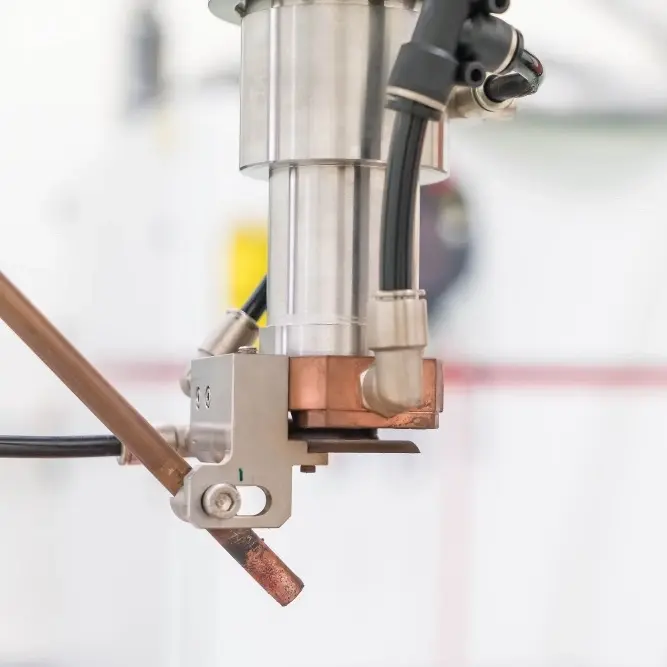
If engineers are building or deploying robots that operate around people, actuator selection becomes a critical design decision. While rigid actuators can deliver high precision, they also introduce the risk of dangerous force spikes when unexpected contact occurs. Series Elastic Actuators (SEAs) address this challenge through a simple but effective concept: placing a spring between the motor and the load.
What are Series Elastic Actuators?
A Series Elastic Actuators (SEAs) are a type of actuator that places a compliant spring element between the gearbox and the robot’s output link, so force passes through the spring rather than a rigid drive train. The concept was first pioneered in 1995 by Pratt and Williamson from MIT and was developed specifically for robots that interact with people, where rigid force spikes can cause injury or damage.[1]
The spring is placed in series with the actuator, meaning the drive chain goes from the motor to the gearbox, then through the spring before reaching the output, rather than using a parallel elastic element that assists the motor from the side. In a nutshell, the spring acts not just as a cushion, but as a force sensor, where deflection corresponds to force according to Hooke’s Law, as well as a shock absorber and an energy store, all in a single mechanical element.
How Does it Work?
The motor drives through the gearbox as normal, but before that torque reaches the output, it passes through the spring. The controller measures how much the spring deflects, and that deflection indicates how much force is being applied, without requiring an external force sensor.
Most traditional actuators are position-controlled, whereas series elastic actuators are designed for force control. The spring deflection provides a direct and low-noise torque reading, making these systems well suited for tasks where contact force matters, such as pushing, lifting, or interacting with a human arm.
The spring also stores kinetic energy during braking and releases it when needed. This behavior is particularly useful in legged robots, where it functions similarly to a human Achilles tendon by storing energy on impact and returning it during push-off.
This video demonstrates how a series elastic actuator uses an intermediate spring to create compliant, force-controlled motion that is safer and more adaptable in real-world interactions.
Key Benefits of SEAs
The spring provides intrinsic safety by physically limiting how quickly force can build up. Regardless of what the software commands, the spring cannot transmit a dangerous spike instantaneously, which creates a hardware-level safety guarantee rather than relying on software alone.
Measuring the spring’s deflection gives a direct estimate of torque, allowing force sensing without additional hardware. This removes the need for external load cells or torque sensors, reducing cost, weight, and potential points of failure.
The spring also improves energy efficiency by storing elastic energy during deceleration and releasing it in the next cycle. Research published in Science Robotics in 2024 found that elastic energy-recycling actuators can reduce power consumption by at least 50 percent, and up to 97 percent in optimal conditions.[2]
Where are SEAs Used?
SEAs are now used across many areas of robotics where safe, precise force interaction matters most.
Rehabilitation and Wearable Systems
Exoskeletons for joints like the knee, elbow, and ankle rely on SEAs to deliver smooth, compliant torque that follows human motion. Recent work, including a 2025 study in Frontiers in Robotics and AI, has even demonstrated low-cost, 3D-printed SEA designs that make rehabilitation devices more accessible to clinics and research teams.[3]
Locomotion and Manipulation
In legged robots, SEAs help absorb impact and recycle energy during walking, improving efficiency and stability in bipedal systems. The same principle extends to dexterous robotic hands, where embedded SEAs allow robots to infer grasp force, contact conditions, and object stiffness without needing dedicated tactile sensors.[4]
Specialised and Industrial Environments
SEAs enable new capabilities in constrained settings. MRI-compatible surgical robots use SEA designs with non-electromagnetic actuation to operate safely inside scanners.[4] Collaborative industrial robots benefit from the built-in compliance of SEAs to enforce safe force limits during human interaction, supporting increasingly strict safety standards.
Trade-Offs
SEAs offer clear advantages in force interaction and safety, but they come with trade-offs that matter depending on the application. The built-in spring enables excellent force control and energy efficiency, especially in cyclic tasks like walking or human interaction. However, it also limits response speed and reduces precision in high-speed scenarios, making rigid actuators a better fit for tasks like precision machining or fast pick-and-place systems.
The main technical constraint is bandwidth. The spring introduces compliance that slows how quickly the actuator can respond to rapid command changes. This is usually acceptable for contact-rich or human-interactive tasks, but it becomes a limitation in applications that demand fast, precise motion.
There is also added control complexity. Achieving high performance with SEAs often requires more advanced control strategies such as observer-based or adaptive methods. This increases development effort and may require specialized expertise, which should be considered during system design.
| Factor | Series Elastic Actuator (SEA) | Rigid Actuator |
| Force Control | Excellent (direct spring measurement) | Poor (requires external sensors) |
| Bandwidth | Limited (spring reduces response speed) | High (direct drive response) |
| Safety | Hardware-level compliance | Software-based limits |
| Energy Efficiency | High in cyclic tasks | Better for high-speed static tasks |
| Precision | Lower at high speeds | Higher for fast position tracking |
| Best Fit | Human interaction, exoskeletons, legged robots | CNC, high-speed automation |
Conclusion
Series Elastic Actuators offer a practical way to make robots safer, more efficient, and better at handling real-world interactions by shifting the focus from rigid position control to compliant force control. While they are not ideal for high-speed or ultra-precise applications due to bandwidth and control complexity limitations, they excel in environments where contact, safety, and energy efficiency matter most.
References:
- Pratt, G. A., & Williamson, M. M. (1995). Series Elastic Actuators. Massachusetts Institute of Technology. Retrieved April 18, 2026, from
https://fab.cba.mit.edu/classes/865.15/people/rebecca.kleinberger/assets/papers/SEA_Pratt.pdf - Kim, et al. (2024). [Elastic energy-recycling actuator study]. Science Robotics. Retrieved April 18, 2026, from https://doi.org/10.1126/scirobotics.adj7246
- Scamarcio, V., Tan, J., Stellacci, F., & Hughes, J. (2025). Reliable and robust robotic handling of microplates via computer vision and touch feedback. Frontiers in Robotics and AI. Retrieved April 18, 2026, from https://doi.org/10.3389/frobt.2025.1528266
- Design and control of a compact series elastic actuator module for robots in MRI scanners. IEEE. Retrieved April 18, 2026, from https://ieeexplore.ieee.org/document/10883563
End-of-arm tooling transforms generic robots into specialized tools
by Jeremy Cook, contributor to GlobalSpec Industrial robot arms – whether six-axis, SCARA, delta or [...]

5 Cybersecurity Threats in Automated Systems
Cybersecurity challenges continue to be a problem in the industrial automation field. In 2025, 50% [...]
Aug
Robot Operating System 2026: 5 Tips for Buyers
For more than ten years, the Robot Operating System (ROS) has served as the backbone [...]
Aug
Digital Twins in Robotics: 5 Things to Know
Robot digital twins are transforming the way robots are built, programmed, and maintained, and they [...]
Jun

Top 6 CNC Machine Trade Shows 2026
We’re halfway through 2026, and the most important CNC machine trade shows are still ahead. [...]
Jun
What is Time Sensitive Networking?
In modern manufacturing, robots, sensors, and motion control devices must be in total harmony with [...]
1 Comments
May