
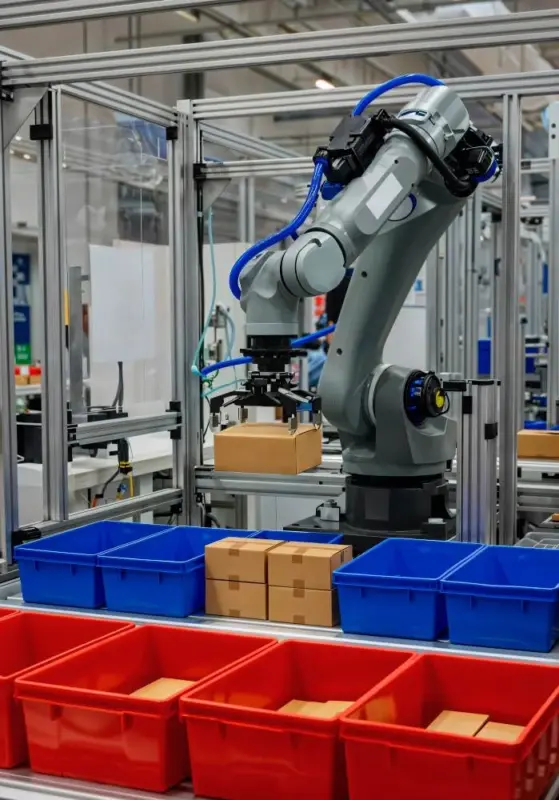
A turnkey system and a custom-built cell will rarely cost what the initial quote would suggest. The headline price covers only part of the investment, and the gap between quote and final spend depends on five factors that apply across industrial automation projects, regardless of size.
1. Engineering hours drive the price, not the hardware
Robot hardware has become cheaper over the past decade, but this decline masks where the real cost sits. Research from MIT’s Interactive Robotics Group, based on interviews with European robot manufacturers, integrators and original equipment manufacturers (OEM), found that the cost of a robot is “a small fraction of the overall price tag of introducing automation to a manufacturing line.” One large integrator summarised the pattern directly: “Robots are now inexpensive, but integration is not”.[1]
The International Federation of Robotics (IFR) gives a figure for this gap. Its General Secretary has stated that programming and integration account for 50 to 70 percent of the cost of a robot application, which leaves the robot and all other equipment to share the remaining 30 to 50 percent.[2] Custom builds multiply the engineering time further, since every workcell, fixture and control sequence is designed from scratch rather than adapted from an already existing template.
2. Lead time carries a cost of its own
Custom work adds time before any equipment reaches production, and that time has a price. A case in the NIST Manufacturing Extension Partnership’s Automation 101 guide shows the scale. A Wisconsin metalworking manufacturer needed a cell for wire spot welding, an application the guide says calls for a custom provider. A $7,500 feasibility study came first, the search for a suitable vendor took nearly six months, and the first cell then cost $107,000.[3] The same guide advises looking first at commercial off-the-shelf solutions, which it describes as generally less expensive and easier to implement than custom ones, and notes that many companies plan 12 to 18 months to reach full production in an automation initiative.[3]
The American Society of Mechanical Engineers reaches a similar conclusion from the component side. Off-the-shelf parts are more likely to be in stock and have a long record of testing, and standard parts are faster to use than custom-designed ones, which lengthen the overall production process.[4]
3. Standardized parts cost less to keep running
Maintenance cost depends heavily on how quickly a failed part can be replaced. PMMI’s 2025 Aftermarket Parts & Service Report found that 75 percent of end users in packaging and processing named immediate parts availability and fast lead times among their top expectations of equipment suppliers.[5] Standard components suit that expectation. ASME notes that off-the-shelf items are more likely to be in stock and are carried by more suppliers, which limits the disruption if a preferred supplier fails.[4] The NIST guide adds that many smaller manufacturers have no maintenance department and advises planning long-term support so that operations do not depend on a single vendor.[3] That goal is harder to meet when specialised parts can only be sourced from the original builder.
4. Flexibility is not free with either option
A common assumption is that standardised, catalogue equipment is inherently more flexible than a custom-built machine. The MIT research complicates that assumption. Robots, even standardised ones, remain difficult to repurpose for new tasks, and the researchers found that even small process changes on a manufacturing line often require calling an integrator back in to redesign the workcell.[1] IFR describes the same problem in cost terms: programming was long uneconomical for high-mix production because changing from one product to another was expensive, although newer programming tools are reducing that barrier.[2] The real cost driver is not turnkey versus custom in the abstract. It is how much re-integration work a process change demands, and that depends on how the original system was engineered, not on the category it started in.
5. Scale determines which option pays off
The same MIT research draws a clear line between firm size and equipment economics: industrial robots are “often only economically viable for high-volume production that takes place in large manufacturing firms”, while small and medium-sized enterprises running high-variety, low-volume production frequently find integration costs prohibitive.[1] NIST describes pre-built solutions as a cost-effective and straightforward option, but notes that the majority of small manufacturers work in high-mix, low-volume environments, which demand more flexible automation.[3] Industrial robotic arms are typically rated for 16,000 hours of operation without failure, with some products rated as high as 80,000 hours, and a typical service life of up to seven years.[1] A custom system optimised for one high-volume process can amortise its engineering cost well within that life. Where work shifts between products, re-integration cost recurs with each change, so how settled the process is matters more than the label on the system.
Matching the option to the operation
| Factor | Turnkey tends to fit | Custom tends to fit |
| Production volume | High-mix, lower volume | High-volume, single process |
| Time to deployment | Faster, tested design | Longer, engineered from scratch |
| Maintenance | Standardized, shorter reorder times | Specialized parts, longer lead times |
| Process stability | Process still being refined | Process fixed and well understood |
| Engineering cost | Spread across many buyers of the same design | Concentrated in one build |
For a small or mid-sized manufacturer without in-house engineering capacity, a turnkey system generally keeps deployment time and integration risk lower. For a large manufacturer running a single high-volume process for years, a custom-engineered system can justify its higher upfront engineering cost through efficiency gains that a general-purpose design cannot match. The choice depends less on company size alone and more on how settled the process is and how long the equipment will run without significant change.
Conclusion
Turnkey and custom automation both carry real costs beyond the quoted price. Engineering hours, lead time, maintenance and process stability determine which option pays off. Smaller operations with shifting needs tend to favor turnkey systems, while large, stable, high-volume processes often justify custom engineering over the equipment’s working life.
References
- Sanneman, L., Fourie, C., & Shah, J. (2020). The state of industrial robotics: Emerging technologies, challenges, and key research directions. Retrieved September 29, 2026, from https://www.therobotreport.com/wp-content/uploads/2021/01/2020-Research-Brief-Sanneman-Fourie-Shah.pdf
- International Federation of Robotics. (2023, February 27). Traditional robot programming vs. AI & machine vision.Retrieved September 29, 2026, from https://ifr.org/post/traditional-robot-programming-vs-ai-machine-vision
- NIST Manufacturing Extension Partnership. (2025). Automation 101: How to plan for successful implementation.Retrieved September 29, 2026, from https://www.nist.gov/system/files/documents/2025/03/28/MEPNN_Automation%20101_508.pdf
- ASME. (2023, March 28). 6 ways to improve time to market. Retrieved September 29, 2026, from https://www.asme.org/topics-resources/content/6-ways-to-improve-time-to-market
- PMMI. (2025). PMMI unveils aftermarket parts & service report: Essential insights for 2025 and beyond. Retrieved September 29, 2026, from https://www.pmmi.org/news/pmmi-unveils-aftermarket-parts-service-report-essential-insights-for-2025-and-beyond