
by Jeremy Cook, contributor to GlobalSpec
Industrial robot arms – whether six-axis, SCARA, delta or any number of other embodiments of this concept – are typically purchased as off-the-shelf items. While factory automation engineers can choose from a variety of brands, models and options, at the end of the day, they are typically buying a general-use robot arm. It may be quite good, but it is not something designed for a specific job… yet.
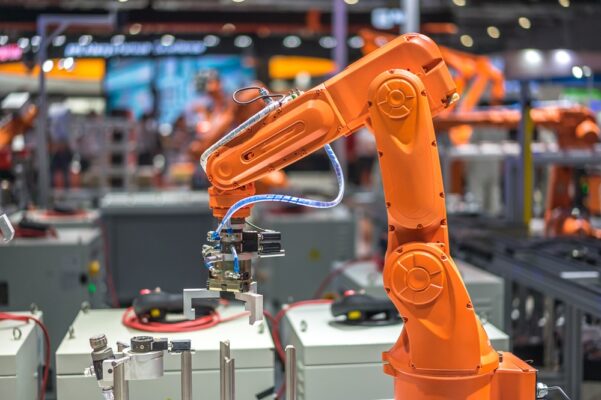
To adapt a generic robot to a specific process, engineers are tasked with specifying, customizing and (in some instances) designing from scratch the system’s end effector assembly. Broadly, this is known as end-of-arm-tooling (EOAT) or, as one might put it in layman’s terms, the robot’s hand.
 What is EOAT?
EOAT is the interface between a robot arm and the rest of the world, consisting of one or more gripers, process tools like welding attachments, cameras for inspection or parts tracking, or any other implement needed to perform an automation task. EOAT can be customized according to process needs and is securely affixed to the robot via a tooling plate located at the end of the robot’s arm. Proper EOAT design can require significant engineering expertise, and its implementation can make or break an automation process.
Classes of EOAT
EOAT can be broken up into three main categories: material handling and palletization, direct processing, and quality assurance. Each has its own capabilities, which can be implemented or even combined to handle specialized automation tasks.
Material handling and palletization
In many industrial operations, parts are transported from one location to another so that stationary tooling can perform processing tasks. When robot arms are implemented for materials handling, EOAT must be properly specified, and often customized, to grip specific parts. This allows the same type of robot to transport anything from ball bearings, to electrical meters, to packaged sandwiches. Even transporting an entire automobile body is possible with the proper payload capacity and ultra-strong EOAT implementation.
Common material handling EOAT elements include pneumatic and electric grippers, which utilize fingers that open and close to hold parts like a human hand. Magnets, vacuum-powered suction cups, soft robotic grippers and other solutions can also be implemented as expedient. Proper gripper arrangement and tooling design are critical to material handling success.
Direct processing
With the appropriate EOAT implementation, robot arms can act directly on a workpiece. Arguably the most recognizable processing application is a herd of robots arranged about an assembly, welding or painting car bodies. Other direct process actions include driving screws, cutting, polishing and any task required to transform a part from work-in-progress (WIP) to finished good.
While the same robot might be able to do all the process tasks listed above — possibly with a protective covering or internal pressurization for hazardous environments — the class of EOAT used, and how it is implemented, will be drastically different. It is up to automation engineers to ensure the appropriate tools are used for each job.
Quality assurance
Quality assurance is an integral part of industrial automation, often relying on static parts positioning and dedicated stations to check different aspects of WIP or finished goods. Robot arms, however, massively expand how a sensor (or sensors) can be used. In one scenario, material handling-style EOAT is used to pick up a part, which can then be moved in three dimensions to expose the part to a camera, 3D scanner or other sensor for verification.
Alternatively, a camera, 3D-scanner or other sensing package can be installed on the robot itself as EOAT. The robot can then move the sensor around — potentially even within — the workpiece under test. Both scenarios dramatically expand sensor capabilities, potentially eliminating the need for multiple setups and the corresponding costs of additional equipment and process inefficiency.
Robot arms may also feature cameras and other sensors that are used for guidance when picking up or processing WIP. While related to quality assurance EOAT, sensors used in this capacity instead serve as part of an overall setup for direct processing and material handling applications.
Getting the most out of EOAT
While some EOAT is a bolt-on-and-program affair, in many cases there is a huge opportunity for innovative solutions that get the most out of a robot arm. One especially helpful technique is the installation of several actuators in different orientations, allowing the robot to quickly choose between them as needed. For instance, tools X and Y may be installed at a 90º angle to one another, so that when tool X grasps a part, tool Y is effectively out of the picture.
The secondary (tertiary, etc.) EOAT design can be as or more involved than the primary system, though it may not be. For example, a simple protrusion or blunt edge might be enough to close a door on a machining center after a part is inserted. There may be any number of small enhancements that a particular EOAT setup can provide when cleverly utilized.
Of course, tradeoffs must be considered. More tooling typically means more weight and volume, potentially limiting a robot arm’s speed, net payload and work envelope. It may be more expedient to use multiple robots, even when one could perform the task with compound EOAT.
EOAT: critical to automation success
Engineers have many choices when it comes to robot arms, but what could make the difference between a successful implementation and one that is prone to problems is the EOAT. Specifying the proper off-the-shelf system can be a great way to efficiently finish a project. Or, a more involved compound assembly with grippers or other implements customized to a particular automation process, may be appropriate. Either way, these present an opportunity for engineers to flex their design and creativity muscles, while potentially producing an excellent return on investment.
About the author
Jeremy Cook is an engineer and freelance tech journalist who spent over a decade in manufacturing automation. He loves to experiment and build, creating everything from walking robots, to custom printed circuit boards, musical instruments and more. When he’s not writing or making something, he enjoys spending time with his family by the water at his home in Florida. You can find more of Jeremy’s writing on GlobalSpec, or check out his newsletter and YouTube.
