
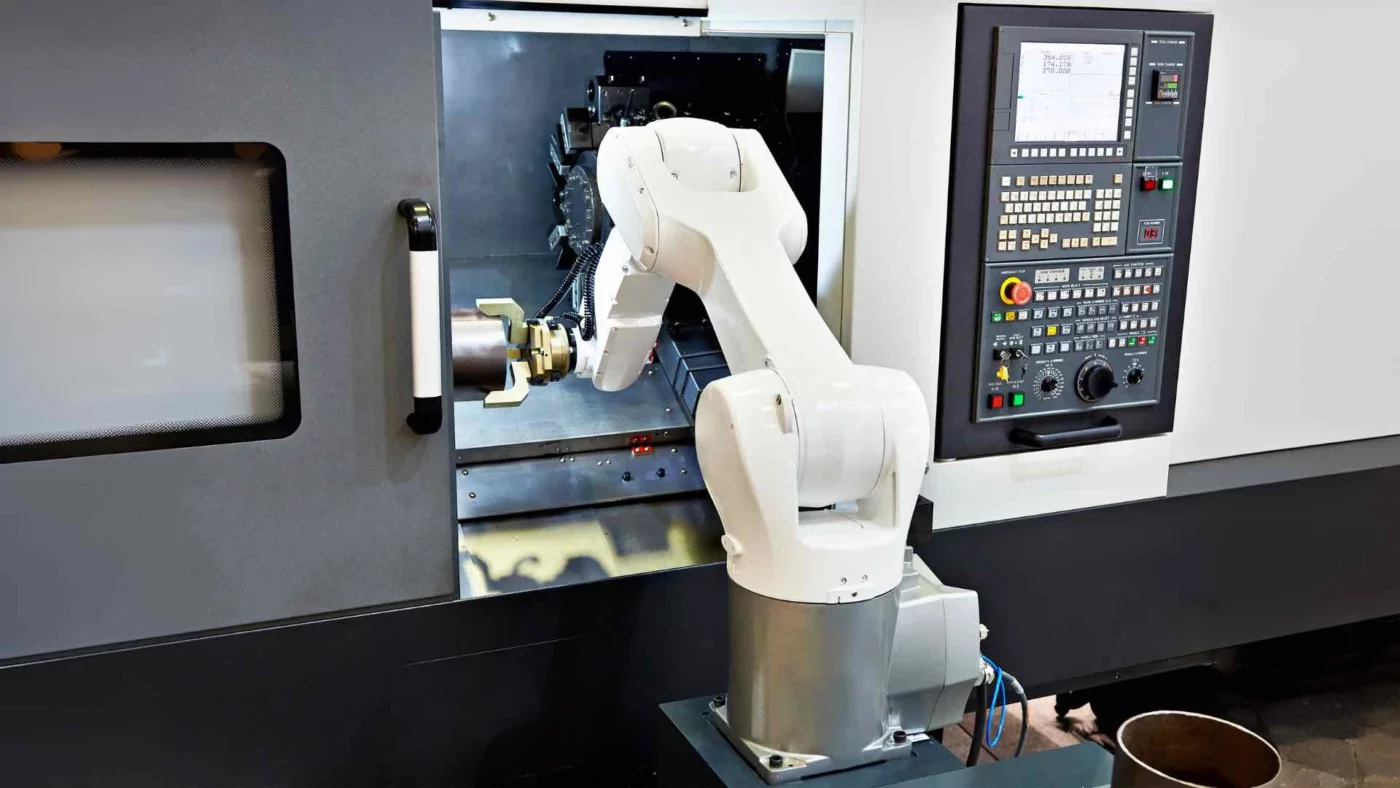
Tending a CNC machine manually takes time and effort. You or your operators must load raw materials, unload finished parts, and stay alert to avoid mistakes. Fatigue slows things down, and machines sit idle when no one is available. With automation, a robot with 3D vision handles the process on its own—working nonstop, reducing errors, and boosting output. You save on labor costs, increase efficiency, and keep production running 24/7. If you want a faster, more reliable process, switching to robotic CNC tending is the way forward.
What is Machine Tending?
Machine tending involves loading raw parts, running your CNC machine, and unloading finished parts. Automating this process with a robot saves time, reduces errors, and keeps your machines running without interruption.
Why Machine Tending Matters:
- Consistent Quality – A robot repeats the same task without errors, ensuring every part meets your standards.
- More Uptime – Unlike humans, robots don’t take breaks. Your machines stay productive 24/7.
- Safer Work Environment – Robots handle repetitive, high-risk tasks, keeping your team out of harm’s way.
- Lower Costs – Automating reduces labor expenses and minimizes material waste from human errors.
If you want a safer, faster, and more cost-effective production process, switching to robotic machine tending is the way to go.
Manual CNC Tending Is Slowing You Down:
You’re Doing Too Much by Hand:
Loading parts. Starting cycles. Monitoring machines. Unloading finished parts. You and your team repeat this all day. It’s physically demanding and exposes your staff to sharp edges, hot surfaces, and moving equipment. Over time, this leads to fatigue, back pain, and safety risks.
Fatigue Leads to Mistakes:
When your team gets tired, errors happen. A mistimed cycle or misplaced part can cause scrap, rework, or even downtime. Each operator handles parts differently, which creates quality issues and inconsistency between shifts.
Your Machines Aren’t Running Enough:
You can’t run your CNC machines during breaks, shift changes, or time off. That idle time adds up fast. Every hour your machine isn’t working, you’re losing output and wasting potential capacity.
The Impact on Your Line:
Manual tending drives up labor costs, limits uptime, and reduces product quality. It also puts a strain on your team, which can lead to turnover or injuries. If you’re still depending on manual work to keep your machines running, you’re not getting the efficiency you need.
SCAPE CNC Machine Tending: A Plug-and-Play Solution
Automate Your CNC Machine Tending:
Manually loading and unloading CNC machines is slow and costly. Scape’s CNC Machine Tending Solution automates this process. A 3D vision-guided robot picks, places, and organizes parts with precision. It runs 24/7, reducing downtime and cutting labor costs. With payback in as little as 12 months, this solution helps you boost efficiency without increasing overhead.
Easy to Set Up, No Modifications Needed:
You don’t have to change your CNC setup. Scape’s system is plug-and-play and works with your existing machines. No complex programming or reconfiguring is needed. Whether you produce small batches or high volumes, the system adapts to your workflow and starts working right away.
Simple to Use, Minimal Disruption:
You don’t need robotics expertise to operate SCAPE’s system. Its no-code interface makes it easy to set up and control. The intelligent 3D vision means parts don’t have to be perfectly placed, the robot finds and picks them automatically. This reduces setup time and gets your production running faster. With Scape, you get quick installation, minimal training, and immediate results.
Key Benefits:
| Key Benefit | Description |
|---|---|
| Free Proof of Concept | Test the system before you commit. SCAPE lets you try it on your machines, risk-free. |
| No Manual Sorting | SCAPE’s 3D vision recognizes and picks parts as they come, reducing prep time and errors. |
| 24/7 Productivity | The system runs continuously without supervision, boosting output. |
| Fast ROI | Break even in about 12 months by saving on labor, reducing downtime, and increasing machine use. |
| No Coding Needed | The no-code interface makes it easy for anyone on your team to use. |
Real-World Results:
Proven in the Field:
At TNDA Gas Equipment, Scape’s system is automating three CNC machines with a full part cycle time of 40 seconds. The robot handles the complete process:
- Recognizing parts in the bin
- Picking parts, even when stacked or rotated
- Planning the optimal robot path
- Re-orienting parts for precision placement
- Delivering each part with 100% accuracy
This setup keeps production moving non-stop with minimal human input. It’s a real example of how automation scales.
This video shows how the 3D vision-guided robot efficiently picks, loads, and unloads parts, ensuring smooth CNC operation with minimal human intervention.
Try It Before You Commit:
Still unsure? You can test the system risk-free with SCAPE’s free proof of concept. See how it performs on your own machines before making a decision.
See It in Action:
Watch the demo video to see SCAPE working live in a real production environment.
Role of 3D Vision in Robotic CNC Automation:
What is 3D Vision?
3D vision helps robots see depth and shape, just like you do. It uses structured light or cameras to create a 3D model of parts. This allows robots to recognize objects, even if they are randomly placed or overlapping.
How 3D Vision Improves Precision:
With 3D vision, your robot can detect a part’s exact location, size, and orientation. This eliminates guesswork and reduces misalignment errors. A robot with 3D vision picks and places parts with millimeter accuracy, ensuring consistent quality.
Real-Time Adaptability:
Parts won’t always be in the same position. 3D vision allows your robot to adjust in real-time. It scans, calculates, and picks the part correctly—even if it’s tilted, rotated, or stacked. This flexibility reduces downtime and keeps your CNC machines running smoothly.
If you want fewer errors and higher efficiency in CNC automation, 3D vision is the key. It helps your robot work smarter, faster, and with greater accuracy.
ROI Calculations: Cost Savings of CNC Automation
Manual vs. Automated CNC Machine Tending Costs:
If you rely on manual CNC tending, labor is one of your biggest expenses. Let’s break it down:
- A CNC machine operator earns an average of $25 per hour.
- With two shifts per day, that’s $400 per day or $8,000 per month in labor costs for just one machine.
- Factor in overtime, training, and errors, and costs rise even more.
- Machine downtime due to breaks and shift changes also affects productivity.
With automation, you eliminate these inefficiencies. A robot works 24/7, doesn’t take breaks, and maintains a consistent production rate. Studies show that robotic automation can cut labor costs by up to potentially 60%.
Fast ROI: Payback in 12 Months:
Let’s say you invest $100,000 in a robotic CNC tending system, such as the SCAPE CNC Machine Tending Solution.
- If you save $8,000 per month in labor costs, that’s $96,000 per year in savings.
- Add reduced scrap and downtime savings, and your payback period can be as short as 12 months.
By automating CNC tending, you reduce costs, increase uptime, and improve quality. Within a year, your investment starts generating profit, making automation a cost-effective long-term solution.
Conclusion:
Switching to 3D vision-guided CNC automation helps you cut costs, reduce errors, and keep production running 24/7. No more relying on operators for manual loading and unloading. No more wasted time or costly mistakes. SCAPE CNC Machine Tending gives you a plug-and-play solution that works with your machines, requires no coding, and delivers a fast ROI, sometimes in just 12 months. You get higher efficiency, lower costs, and a safer workplace. Want to see it in action? Test it risk-free with a free proof of concept and start making your CNC process faster, smarter, and more reliable today.
Structured Light vs. Time-of-Flight Cameras
Depth sensing enables robots to perceive the three-dimensional structure of their surroundings. It supports tasks [...]
Mar
Human Machine Interface Explained
If you have automated equipment, you interact with a human machine interface on a daily [...]
Feb

Why Most Humanoid Robots Lack AI Stacks
Humanoid robots are robots built to look and move like humans. They usually have two [...]
Feb

January 2026 Humanoid Robot Launches
January marked a major milestone for the humanoid robotics sector, as several leading manufacturers unveiled [...]
Jan

Top 5 Humanoid Robot Trade Shows 2026
Humanoid robots are multiplying fast. Companies are taking unique approaches to solve real-world problems. In [...]
1 Comments
Jan

Which Humanoid Robots Launch in 2026?
2026 is shaping up to be a breakthrough year for humanoid robots. Several tech giants [...]
Aug

Robotic CNC tending truly seems like the future of manufacturing. By taking over repetitive and high-risk tasks, robots can not only improve safety but also enhance consistency and reduce errors across production lines.
Hi everyone! I’m truly fond of reading the posts on this website, as they’re regularly updated with great content. It contains some really nice stuff.
Thanks for the marvelous posting! I definitely enjoyed reading it. You’re going to be a great author. I’ll be sure to bookmark your blog and come back at some point. I want to encourage you to continue your great posts. Have a nice afternoon!