
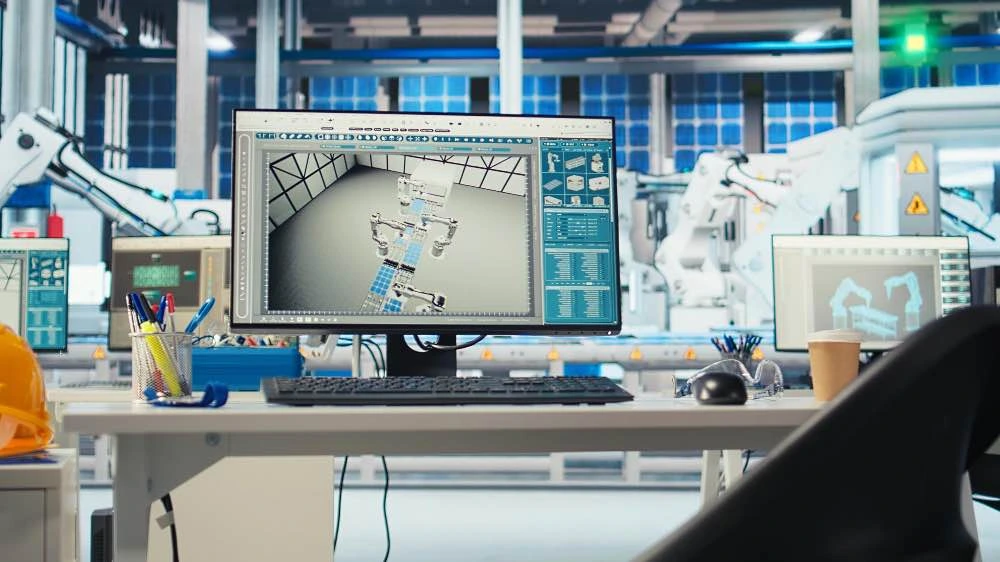
For more than ten years, the Robot Operating System (ROS) has served as the backbone for robotics projects of every kind, from academic research labs to commercial automation lines. Despite its name, ROS is not an operating system in the conventional sense. Rather, it is an open-source framework that provides developers with the tools, libraries, and communication infrastructure needed to build robotic applications. But the landscape is shifting. ROS 1 has officially reached end-of-life, ROS 2 continues to gain ground, and a new wave of AI-driven robots is emerging with software architectures that look nothing like what came before. Here are five things every robotics buyer should understand before building on it.
5 Things to Know About ROS in 2026
1. The ROS Ecosystem Is Still Growing, Even as Robotics Evolves
Much of the debate around ROS centers on whether newer robotics platforms will eventually replace it. But zoom out, and the wider ecosystem built around ROS is still expanding, especially in research, autonomous systems, and commercial robotics development. Open Robotics’ annual ROS Metrics reports point to continued activity across ROS distributions, with ROS 2 adoption climbing as developers move away from ROS 1 toward newer, long-term-support versions.[1]
That growth doesn’t mean ROS has become the default software layer for every robot on the market. Traditional industrial robots still lean heavily on their manufacturers’ proprietary controllers, and newer humanoid platforms are experimenting with entirely different AI-driven architectures. What ROS has become instead is a flexible development ecosystem, one that ties together hardware, software libraries, simulation tools, and robotic applications across a wide range of fields.[2]
2. ROS 1 Is Being Retired, but Migration Is Not Instant
ROS has run for years across two separate versions: ROS 1 and ROS 2. Both give developers a flexible foundation to build robots on, but they’re constructed quite differently underneath. ROS 1 Noetic, the final ROS 1 version, officially hit end-of-life on May 31, 2025, ending regular updates and support from the ROS community.[3]
But here’s the reality: moving from ROS 1 to ROS 2 isn’t just a software patch. Most robotics systems in the field carry custom packages, hardware-specific integrations, and application code developed over years of real deployment. Migrating that work to ROS 2 means extensive testing, rebuilding parts of the system, and validating that everything keeps working as it should.
For companies starting robotics projects today, the guidance is straightforward: new builds should go on ROS 2. For organizations still running ROS 1, a clear migration strategy that will address ongoing maintenance, security issues, and compatibility concerns.
3. On the Factory Floor, ROS Plays a Different Role Than Many Expect
Manufacturing tasks like welding, assembly, and high-speed material handling still depend on dedicated robot controllers built for deterministic motion, safety compliance, and long-term reliability on the production line. In these settings, manufacturers’ own proprietary control systems continue to own the lowest-level motion control.[4]
That doesn’t mean ROS is absent from industrial robotics, though. It typically shows one layer up, connecting robots to external systems, sensors, simulation environments, and higher-level capabilities like perception and planning. The ROS-Industrial Consortium exists precisely for this purpose, building industrial drivers, interfaces, and tools that let ROS-based software talk to factory hardware.[5]
For buyers, the key distinction is understanding where ROS sits in the architecture, not simply whether a robot supports it.
4. Humanoid Robotics Is Changing What Robot Software Needs to Do
Humanoid robots powered by AI are forcing a reckoning with what robotics software must now accomplish: handling perception, reasoning, and physical manipulation all at once, and doing it in environments that aren’t carefully controlled or predictable. As companies build these systems, they’re creating specialized AI platforms tailored specifically to meet these demands.[6]
Vision-language-action (VLA) models are central to this shift. Rather than splitting perception, planning, and control into separate, disconnected pieces, VLA approaches weave visual understanding, natural language comprehension, and physical control together into a single model. Figure AI’s Helix, NVIDIA’s GR00T, and Google DeepMind’s Gemini Robotics are all pushing in this direction.[7][8][9]
For buyers evaluating humanoid robots, software priorities shift. Instead of ROS compatibility, what matters is whether the robot can successfully tie together its middleware, AI models, simulation tools, and control systems to operate independently.
5. ROS-Industrial Bridges Gap for Manufacturers
The role of ROS remains essential in manufacturing through the ecosystem surrounding ROS-Industrial. The consortium provides the drivers, interfaces, and tools that connect ROS-based applications with commercial robot platforms and factory systems, bridging the gap between open-source software and manufacturer-specific hardware.[5]
Manufacturer support for this approach is growing. FANUC, for instance, released an official ROS 2 driver for its CRX collaborative robot series, giving developers a manufacturer-backed pathway for building ROS applications with FANUC hardware.[10]
For the perspective of buyers, ROS compatibility is not the same as ROS-native support. It is important to understand the nature of integrations (manufacturer-backed vs. community-supported).
Conclusion
ROS is still a legitimate option for robotics projects, but it’s stopped being the obvious go-to choice. ROS 1’s end-of-life, factory floors’ reliance on manufacturer-specific controllers, and humanoid companies betting on proprietary AI stacks all complicate the picture. The question isn’t whether ROS still matters. It’s whether a particular project benefits from the flexibility and openness that ROS provides, or whether a purpose-built system tailored to a specific robot would serve better.
References
- Open Robotics. (n.d.). ROS Metrics. Retrieved on 14 July 2026, from https://www.ros.org/metrics/
- Macenski, S., Foote, T., Gerkey, B., Lalancette, C., & Woodall, W. (2022). Robot Operating System 2: Design, Architecture, and Uses in the Wild. Science Robotics. Retrieved on 14 July 2026, from https://www.science.org/doi/10.1126/scirobotics.abm6074
- Open Robotics. (n.d.). ROS Noetic Ninjemys End of Life. Retrieved on 14 July 2026, from https://www.ros.org/blog/noetic-eol/
- KUKA. (n.d.). Robot Controller Technology and Automation Solutions. Retrieved on 14 July 2026, from https://www.kuka.com/en-us/products/robotics-systems/robot-controllers
- ROS-Industrial Consortium. (n.d.). ROS-Industrial Overview and Description. Retrieved on 14 July 2026, from https://rosindustrial.org/about/description
- NVIDIA. (n.d.). Project GR00T: Generalist Robot 00 Technology. Retrieved on 14 July 2026, from https://developer.nvidia.com/isaac/gr00t
- Figure AI. (n.d.). Helix: A Vision-Language-Action Model for Generalist Robots. Retrieved on 14 July 2026, from https://www.figure.ai/news/helix
- NVIDIA. (n.d.). NVIDIA Announces Isaac GR00T N1 Foundation Model for Humanoid Robots. Retrieved on 14 July 2026, from https://nvidianews.nvidia.com/news/nvidia-isaac-gr00t-n1
- Google DeepMind. (n.d.). Gemini Robotics: Bringing AI into the Physical World. Retrieved on 14 July 2026, from https://deepmind.google/discover/blog/gemini-robotics-brings-ai-into-the-physical-world/
- FANUC America. (n.d.). FANUC’s Open Platform ROS 2 Driver. Retrieved on 14 July 2026, from https://www.fanucamerica.com/solutions/ros-2
End-of-arm tooling transforms generic robots into specialized tools
by Jeremy Cook, contributor to GlobalSpec Industrial robot arms – whether six-axis, SCARA, delta or [...]

5 Cybersecurity Threats in Automated Systems
Cybersecurity challenges continue to be a problem in the industrial automation field. In 2025, 50% [...]
Aug
Robot Operating System 2026: 5 Tips for Buyers
For more than ten years, the Robot Operating System (ROS) has served as the backbone [...]
Aug
Digital Twins in Robotics: 5 Things to Know
Robot digital twins are transforming the way robots are built, programmed, and maintained, and they [...]
Jun

Top 6 CNC Machine Trade Shows 2026
We’re halfway through 2026, and the most important CNC machine trade shows are still ahead. [...]
Jun
What is Time Sensitive Networking?
In modern manufacturing, robots, sensors, and motion control devices must be in total harmony with [...]
1 Comments
May